
 FEATURED
Operations / Audit PDF
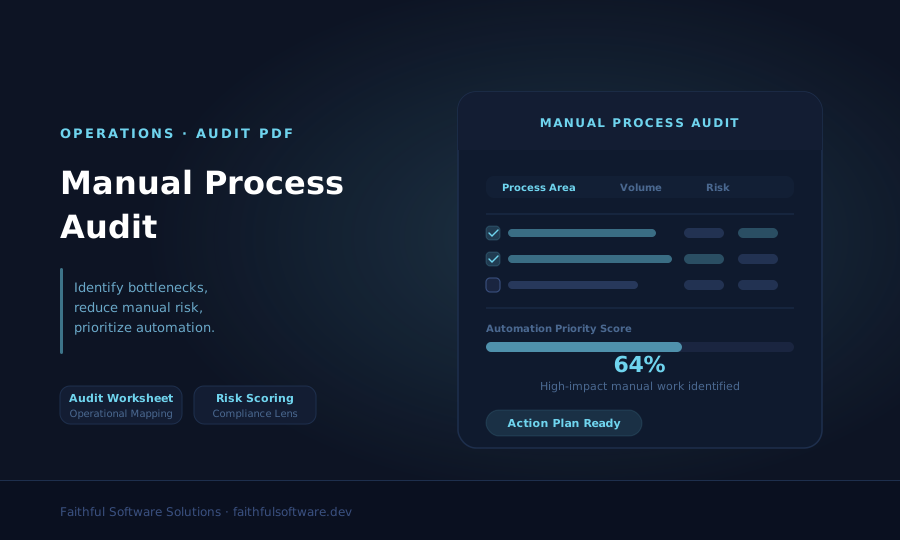
Manual Process Audit
A practical audit workbook to spot manual bottlenecks, compliance risks, and high-impact automation opportunities.
Get the manual process auditCompare configuration, integration and bespoke software against the same outcome, whole-life costs and ownership requirements. Keep assumptions visible and approve the next decision only when its evidence is sufficient.
By Faithful Software Solutions Ltd
Published · Updated
For Charity leaders, Church administrators, Operational software buyers.
First-party scope and product information. Workflow examples are illustrative; no measured customer outcomes are claimed.
A software investment scoring model for business impact, risk, and effort
A prioritization matrix for modernization initiatives and platform upgrades
A governance checklist for procurement, delivery, and measurable outcomes
Submit once to unlock immediate download access.
By downloading, you agree to receive strategic updates. Unsubscribe anytime.
Step 1
Capture current and planned software investments across modernization, integration, and platform work.
Step 2
Score each initiative by business impact, implementation effort, and operational risk.
Step 3
Use the ranking output to focus budget, sequencing, and governance on the highest-value work.
Complete the resource with the people who own the process and agree which open question to resolve next.
Compare the same operational outcome across keeping the current process, configuring an existing product, integrating tools and commissioning bespoke work. Record evidence, assumptions, one-off costs and recurring responsibilities for each option. The existing framework PDF supports the decision; these examples explain how to apply it.
Start with the problem, its owner, the essential tasks and the consequence of doing nothing. Record available evidence beside each expected benefit. Separate measurable observations from assumptions and decide what would disprove the business case.
Include discovery, configuration or build work, migration, training and launch. Then record subscriptions, hosting, maintenance, support, staff administration and the cost of leaving. The software cost guide explains scope drivers without treating an illustrative budget as a quotation.
Consider an illustrative programme team copying referral status into a funder report. Compare improving the existing export, joining supported data sources and building a reporting workflow. Test whether source definitions agree before promising faster reporting.
Record staff time as potential capacity released. Do not count the same hours as both salary savings and additional delivery capacity. Use the Manual Process Audit to collect baseline evidence.
An illustrative church reviewing registration and volunteer coordination could compare a configured church management product, a targeted portal and a bespoke release. Include occasional users, access removal when volunteers leave and a fallback process during downtime.
Use the church software comparison to structure product trials. Ask users to complete representative tasks and record which essential needs remain unmet.
Present a preferred option with reasons, material uncertainties, a named owner and a first decision boundary. A discovery phase can be approved to test a risky assumption before a wider commitment. State what evidence would cause you to pause or choose another option.
Scoring helps organise a discussion; it should not hide a serious dependency behind an average score. Do not present estimated returns as guaranteed outcomes.
Complete the Software Project Readiness Kit for the preferred option. Ask suppliers to use the same scope, exclusions and acceptance criteria so the next comparison is defensible.
FEATUREDOperations / Audit PDF
A practical audit workbook to spot manual bottlenecks, compliance risks, and high-impact automation opportunities.
Get the manual process audit FEATURED
Implementation / PDF workbook
Prepare a clear software brief with your process owner, budget holder and delivery team.
Get the software readiness kitWant to learn more? Read our blog or talk to FSS directly.